
A CRM for real estate agents exists to solve one specific problem: leads go cold because follow-ups are inconsistent, untracked, or too slow. Most agents don’t lose deals because they lack leads — they lose them because nobody nurtured those leads at the right moment, in the right way. Fixing that gap is the fastest lever most agencies have for growth.
Why Lead Nurturing Fails Without the Right CRM for Real Estate Agents
Lead nurturing fails when follow-ups depend on memory instead of a system. The moment an agent relies on sticky notes, WhatsApp chat history, or a mental to-do list to track hundreds of prospects, some percentage of those leads simply fall through the cracks — not because the agent doesn’t care, but because human memory wasn’t built for that kind of volume.
[Insert stat: Industry reports suggest that businesses responding to a lead within 5 minutes are significantly more likely to convert it than those that wait an hour or longer.] Real estate compounds this problem because the sales cycle is long — weeks or months — which means a lead can quietly go cold long before an agent even notices.
This is exactly the gap a CRM for real estate agents is designed to close: it turns lead follow-up from a memory exercise into a repeatable, trackable process.
The Real Cost of Poor Lead Management in Real Estate

Poor lead management doesn’t just lose individual deals — it quietly erodes marketing ROI across the board. Every rupee spent on Facebook Ads, Google Ads, or property portal listings is wasted the moment a captured lead sits unattended in an inbox or spreadsheet.
Real estate lead management mistakes typically show up in three places:
- Leads captured from ads never get assigned to an agent in real time
- Follow-ups happen once, then stop
- There’s no visibility into which leads are hot, warm, or cold
[Insert stat: According to industry data, a large share of real estate leads never receive a second follow-up attempt.] That single gap is often the difference between an agency that scales and one that plateaus.
10 Lead Nurturing Mistakes That Are Killing Your Conversions
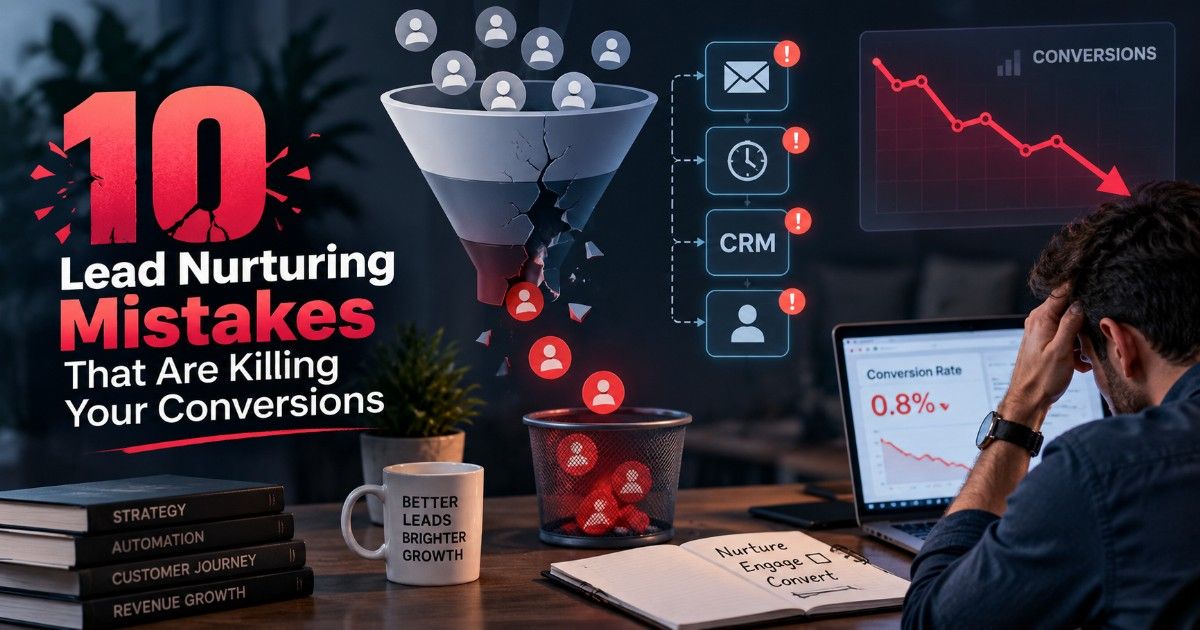
These are the patterns that show up again and again across real estate teams — from solo brokers in Kolkata to mid-sized agencies managing hundreds of listings.
1. Treating Every Lead the Same Way
Not every lead deserves the same follow-up cadence. Someone who just downloaded a brochure is not as ready to buy as someone who requested a site visit, yet many agents send identical messages to both. Lead scoring for real estate agents — ranking leads by intent and behaviour — fixes this by telling the team exactly who to call first.
2. Responding Too Slowly
Speed is the single biggest lever in real estate lead conversion tips that agents underestimate. A property inquiry sent at 9 PM and answered the next afternoon has already lost most of its urgency. Buyers are usually comparing three or four options simultaneously — the first agent to respond meaningfully often wins the relationship, not necessarily the best deal.
3. Following Up Once and Giving Up
One call, one message, then silence — this is one of the most common real estate lead management mistakes. Real buyers rarely commit on the first conversation. It typically takes several touchpoints across calls, WhatsApp, and email before a lead is ready to move forward, and most agents stop long before that point.
4. No System for Tracking Where Each Lead Stands
Without a shared pipeline, two agents can end up calling the same lead while three others go completely untouched. This is exactly why real estate leads don’t convert even when the marketing spend is healthy — the problem isn’t demand generation; it’s internal visibility.
5. Relying on Manual, Disconnected Tools
Spreadsheets, personal WhatsApp, and sticky notes might work for ten leads. They collapse completely at a hundred. Agents end up spending more time managing the tracking system than actually talking to buyers, which defeats the purpose of generating leads in the first place.
6. Ignoring WhatsApp as a Nurturing Channel
In the Indian real estate market particularly, phone calls often go unanswered, but WhatsApp messages get read within minutes. Agencies that don’t automate WhatsApp follow-ups are leaving one of the highest-engagement channels completely untouched.
7. No Personalisation in Follow-Up Messages
Generic, copy-pasted messages read as spam and get ignored. Buyers respond to messages that reference the specific property, budget range, or location they asked about — something only possible when lead details are actually stored and accessible, not scattered across someone’s phone.
8. Not Segmenting Leads by Property Type or Budget
A lead interested in a 2BHK in Kolkata and a lead looking at luxury villas in Delhi shouldn’t be in the same nurturing sequence. Segmentation lets agents send relevant listings instead of a generic newsletter that gets deleted unread.
9. Missing Follow-Up Reminders Entirely
Even organised agents forget. Without automated reminders, a “call back next week” note in a notebook has a real chance of never actually happening, especially when an agent is juggling 40+ active leads at once.
10. No Visibility Into What’s Actually Working
Without reporting, there’s no way to know which lead source, campaign, or agent is converting best. Agencies keep spending on the same channels out of habit rather than data, because nobody can see the numbers clearly enough to make a better call.
How to Nurture Real Estate Leads the Right Way
How to nurture real estate leads effectively comes down to three things: speed, consistency, and relevance. Respond within minutes, follow up on a fixed schedule rather than “when I remember,” and tailor every message to what that specific buyer actually asked for.
This is where real estate crm software earns its place in an agent’s toolkit — not as a nice-to-have dashboard, but as the infrastructure that makes speed and consistency possible at scale, across dozens or hundreds of leads at once, without relying on any single person’s memory.
CRM for Real Estate Agents: A Quick Comparison of Options
Choosing between manual tracking, a generic business CRM, and an industry-specific tool depends heavily on team size and budget. Here’s how the main options stack up for real estate lead nurturing specifically:
| Option | Best Use Case | Core Benefit | Recommendation |
|---|---|---|---|
| Spreadsheets / Manual Tracking | Solo agents with under 20 active leads | Zero cost, no learning curve | Fine short-term, but breaks down fast as lead volume grows |
| Generic CRM (e.g., Salesforce, HubSpot) | Large enterprises with dedicated CRM admins | Deep customisation and broad integrations | Often overpriced and over-complicated for real estate-specific workflows |
| Industry-Specific Real Estate CRM | Agencies and brokers needing property, lead, and follow-up management in one place | Built-in features for listings, lead scoring, and WhatsApp/SMS automation | Best fit for most real estate businesses in India and abroad |
| 99salescrm | Independent agents to mid-sized agencies wanting an affordable, real-estate-ready CRM | Automated lead assignment, WhatsApp/SMS follow-ups, and real-time analytics in one platform | Strong option when comparing affordable real estate crm software for teams that need results fast without enterprise pricing |
This kind of real estate crm comparison matters because the “best” tool isn’t universal — it depends on whether a team needs enterprise-grade complexity or a lean, purpose-built system that gets set up in days, not months.
How to Choose the Best CRM for Real Estate Agents in India
The best CRM for real estate agents in India should handle three things without extra plugins: automated lead capture from Facebook/Google Ads, WhatsApp-based follow-up sequences, and property-specific lead segmentation. Many international CRMs support none of these natively, which is why India-focused tools have carved out a strong niche.
Beyond features, cost matters just as much. Agencies comparing options for the best CRM for realtors 2027 should weigh more than the sticker price. Consider onboarding costs, support responsiveness, and how quickly the team can start using it. A CRM that takes three months to implement can lose leads during setup.
For teams outside India — particularly independent realtors and small agencies in the US, UK, UAE, and Australia — the calculation is slightly different. Many are paying premium pricing for platforms like Salesforce or HubSpot. Yet, they may only use a fraction of the features. A leaner, real estate lead nurturing software built for property workflows can deliver the same core outcome. It enables faster, better-tracked follow-ups at a fraction of the cost.
Why 99salescrm Is Built Around These Exact Problems

99salescrm was designed specifically to close the gaps listed above, rather than being a generic sales tool retrofitted for property teams. As a CRM for real estate agents, it automatically assigns incoming leads from Facebook and Google Ads to the right agent in real time, removing the delay that kills so many otherwise-winnable deals.
It also builds WhatsApp and SMS automation directly into the follow-up sequence, so leads get a response even outside business hours. Lead scoring flags which prospects are ready to talk to a human versus which ones still need nurturing content, and real-time reporting shows exactly which campaigns and agents are converting — closing the visibility gap that most spreadsheet-based teams never solve.
For agencies weighing real estate crm software options, the practical test is simple: does the tool reduce the number of manual steps between “lead comes in” and “agent follows up”? That’s the problem 99salescrm was built to solve.
FAQ:
What is the best CRM for real estate agents in India?
The best option depends on team size and budget, but most agencies benefit most from an industry-specific CRM rather than a generic enterprise tool. Look for automated lead assignment, WhatsApp/SMS follow-up, and real-time analytics — features platforms like 99salescrm build in by default rather than as costly add-ons.
Why do most real estate leads fail to convert?
Most leads fail to convert due to slow response times, inconsistent follow-up, and no system for tracking where each lead stands in the pipeline. These aren’t demand problems — they’re process problems that a proper CRM is specifically designed to fix.
How many follow-ups does a real estate lead typically need?
Real estate buyers usually need several touchpoints — calls, WhatsApp messages, and emails — spread across days or weeks before they’re ready to commit, since property decisions involve long consideration cycles and multiple stakeholders like family or financiers.
Is a CRM worth it for a solo real estate agent?
Yes, once lead volume exceeds what can be reliably tracked by memory or spreadsheet — usually somewhere around 20-30 active leads. Beyond that point, missed follow-ups start costing more than the CRM subscription itself.
What makes real estate CRM software different from a general business CRM?
Real estate-specific CRMs include property listing management, location/budget-based lead segmentation, and WhatsApp-first communication — workflows generic CRMs like Salesforce or HubSpot typically require expensive customisation to replicate.
Stop Losing Leads to Bad Follow-Up Habits
Every mistake on this list has one thing in common — it’s fixable with the right system, not more effort from your agents. 99salescrm brings automated lead assignment, WhatsApp/SMS follow-ups, lead scoring, and real-time reporting into one platform built specifically for real estate teams — not retrofitted from a generic sales tool.
Whether you’re a solo agent in Kolkata juggling 40 leads on WhatsApp, or an agency running Facebook Ads across three cities, 99salescrm closes the exact gaps this article covered — no missed follow-ups, no cold leads, no guesswork on what’s converting.
👉 Start Your Free Trial of 99salescrm Today — No Credit Card Required
👉 Book a Free CRM Demo and see how fast you can plug these leaks