
A CRM for real estate agents in India decides whether a lead becomes a site visit or stays buried in an Excel row. If you sell property in India, enquiries already reach you from Facebook forms, Google ads, JustDial calls, Instagram messages and walk-ins, and most of them go cold within days when nobody calls back on time. This guide explains what real estate CRM software in India should do, how to set one up in a single afternoon, what it costs, and how to pick a tool without losing a month on the wrong one.
It is written for independent agents, small brokerages and sales managers who handle more than one project and more than one lead source. If you already track every buyer perfectly in a notebook, you can stop here. If you have ever asked “who spoke to this buyer last?” and nobody knew, keep reading.
Key takeaways
- Excel breaks the day two people edit the same lead list, and property deals are too long and too valuable for that.
- Every lead needs one record, one owner and one dated next step.
- Connect Facebook, Google, JustDial and Instagram leads at the source, so nobody retypes them.
Why Every Property Team Needs a CRM for Real Estate Agents in India
Excel works for the first fifty leads. It starts failing the day a second person opens the same sheet.
Property sales make this worse than most industries. A buyer rarely decides after one call. They ask about three projects, compare prices, bring the family for a site visit, disappear for two weeks, and come back with a home loan question. Every one of those touches needs a record, and a spreadsheet row has room for a name, a number and a vague note like “interested, call later.”
Here is what usually goes wrong:
- The same buyer enquires through a Facebook form and a JustDial listing, and two agents call with two different prices.
- A site visit happens on Saturday, but nobody records what the buyer liked, so Monday’s call starts from zero.
- A salesperson leaves and takes the only copy of fifty warm contacts on their phone.
- The owner pays for ads every month and cannot say which source produced actual bookings.
None of these are discipline problems. They are tool problems. A property dealer CRM gives every lead one record, one owner and one next step, so the work stops depending on anyone’s memory.
A Tuesday With and Without a CRM
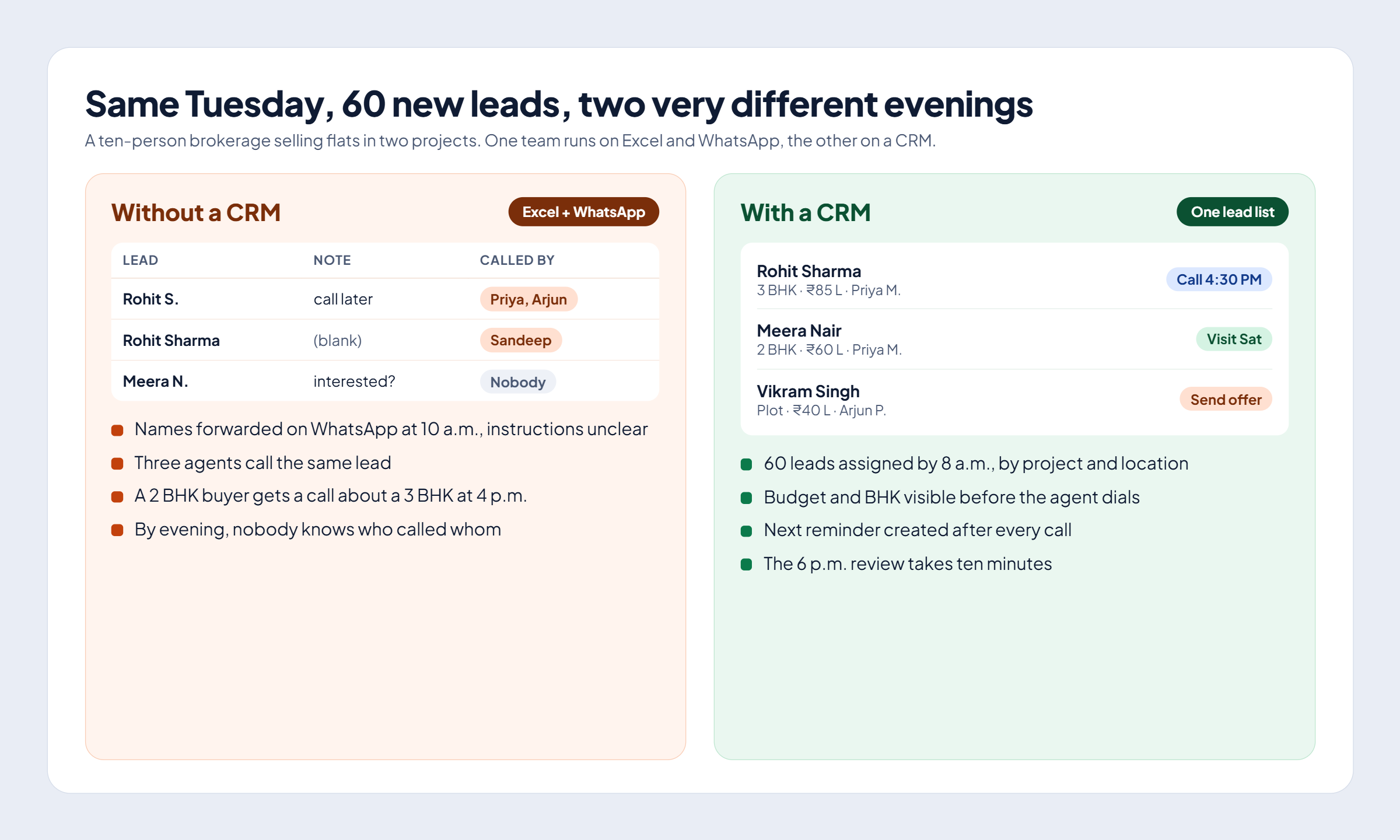
Picture the same Tuesday at a ten-person brokerage selling flats in two projects.
Without a CRM, sixty leads arrived overnight from Facebook and Google. The manager opens a sheet at 10 a.m., forwards names to agents on WhatsApp, and three agents take the same lead because the message was unclear. A buyer who asked for a 2 BHK in the morning gets a call about a 3 BHK at 4 p.m. By evening nobody can say who has called whom.
With a CRM, those sixty leads were already assigned by 8 a.m., by project and location. Each agent opens one screen listing today’s calls, with the buyer’s budget and BHK choice visible before they dial. After each call they pick an outcome, and the next reminder is created for them. At 6 p.m. the manager checks two things: leads with no first call, and site visits booked for the week. The whole review takes ten minutes.
The leads are identical in both versions. The difference is that the second team knows what happened to each one.
Key Features to Look For in a CRM for Real Estate Agents in India
A good CRM is not a bigger spreadsheet. It stores the details that decide whether a buyer closes, and shows them at the moment your agent picks up the phone. Five things matter most.
Lead source and campaign
Record where each enquiry came from: a Facebook lead ad, a Google search campaign, a JustDial listing, an Instagram message or a walk-in. Without this, real estate lead tracking turns into guesswork, and your next ad budget follows opinion instead of results.
Buyer requirement
Budget, BHK type, preferred locality, possession timeline and whether a home loan is needed. These five fields let any agent hold a useful conversation, even with a buyer they have never spoken to before.
Every call and message
Notes, call outcomes and WhatsApp messages belong on the lead, not in personal phones. When an agent is on leave, a colleague should be able to read the history in thirty seconds.
Site visits and what happened
Site visit scheduling should live inside the CRM, with the project, date, time and the agent who accompanies the buyer. After the visit, record the reaction: liked the layout, worried about price, wants a second visit with parents.
Deal stage and value
New, contacted, site visit done, negotiation, booked, lost. Add the expected deal value, so the pipeline shows what is actually likely to close this month and not just how many names you have.
How a CRM for Real Estate Agents in India Handles Facebook, Google and JustDial Leads
Most property enquiries start on someone else’s platform. The goal is that none of them needs to be copied by hand.
Facebook and Instagram. A Facebook lead ads CRM connection pulls form submissions in as they arrive, including answers to questions like budget and preferred location. Ask those two questions in the form itself. Leads who answer them are easier to qualify on the first call.
Google. Lead form extensions and website enquiry forms should post into the same list, tagged with the campaign name, so you can compare search leads against social leads later.
JustDial and portals. These often arrive as calls or emails. Connect or forward them so they land as records with the source marked, not as messages sitting in someone’s inbox.
Walk-ins and referrals. Add them at the front desk with a source tag. Referral leads often convert better than ad leads, and you only learn that if they are labelled.
Any real estate CRM software in India worth shortlisting should handle these sources without custom coding, and it should flag a duplicate when the same phone number appears twice. A proper real estate lead management software setup also assigns each new lead to an agent automatically, by project, location or round-robin, so response time is measured in minutes, not hours.
Speed matters because a buyer who filled a form at 11 a.m. has often filled three others by lunch. The first agent who calls with a clear, informed message usually gets the site visit.
Follow-Ups That Actually Happen
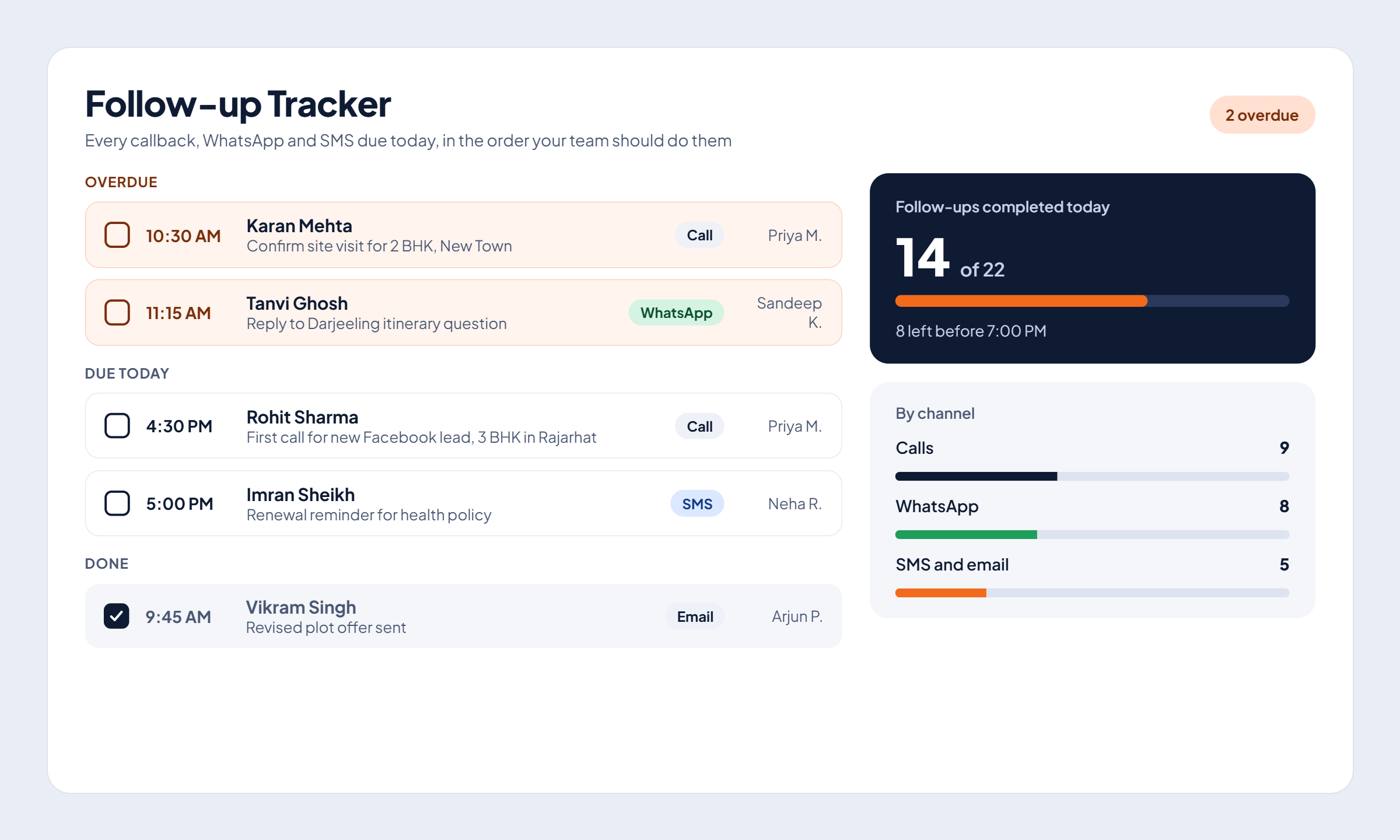
Property decisions take weeks or months, so follow-up is where most deals are won or lost. The trouble is that nobody enjoys remembering forty callbacks a day. Real estate follow-up software removes that burden by turning each call outcome into a dated next step.
Here is a simple rhythm many sales teams use:
- Same day: call within the first hour, then send a WhatsApp message with project details and a location pin.
- Day 2: share the brochure, floor plan or a short walkthrough video.
- Day 5: call to ask which layout interested them and offer a visit slot.
- Day 12: share something new, such as a price revision, a ready unit or a payment plan.
- Day 30: a light check-in for buyers who are still undecided.
Treat this as a starting point, not a rule. Change the gaps to match how long your buyers actually take.
WhatsApp deserves special attention because buyers in India often reply there faster than on calls or email. A WhatsApp CRM for real estate keeps those chats attached to the lead, so a message sent from one agent’s phone is visible to the manager and to the next agent who picks up the conversation. Reminders should show as tasks, with overdue ones listed first, so the day starts with a clear list instead of a scroll through chats.
A Four-Step Setup You Can Finish in One Afternoon
You do not need a long implementation project to start. This sequence keeps it simple.
Step 1: Clean and import your existing leads. Export your Excel sheet, remove duplicates, and make sure every row has a name, a phone number and a source. Even incomplete records are worth importing. Old leads often respond when a new project launches.
Step 2: Define your stages. Six are enough: new, contacted, site visit scheduled, site visit done, negotiation, booked. Resist the urge to add fifteen. Your CRM works best when every stage has an obvious exit condition, so nobody argues about where a lead belongs.
Step 3: Connect your sources. Link Facebook, Google and JustDial first, then add the rest. Send one test lead from each source and confirm it lands with the right tag and the right owner.
Step 4: Set assignment and reminders. Decide who gets which leads, and set the default reminder after each call outcome. Invite the team and show them only two screens at first: today’s tasks and their own lead list. Everything else can wait until week two.
Once pipeline management is running, the manager can see at a glance how many buyers sit at each stage and where deals stall.
Reading the Numbers That Matter
When leads flow in and follow-ups run, reports tell you what to change. Four numbers are enough to start:
- Cost per lead by source. Divide ad spend by leads for each channel.
- Site visit rate by source. A cheap lead that never visits is not cheap.
- Response time. Minutes between the enquiry and the first call.
- Follow-up gaps. Leads with an overdue task, and which agent owns them.
Review them weekly, not monthly. If JustDial brings fewer leads than Facebook but twice the visit rate, move budget accordingly. Good real estate lead tracking is not about collecting more data. It is about making one decision a week with better information. The reports section of a CRM should answer these four questions without exporting anything.
Real Estate CRM Price in India: What to Expect
Pricing varies widely, and the headline number rarely tells the whole story. Most tools charge per user per month. Some add fees for setup, extra storage, WhatsApp messaging or additional lead sources. When you compare real estate CRM software in India on price, ask what is included at the plan you will actually use.
Questions worth asking before you pay:
- Is the price per user or per team?
- Are Facebook, Google and JustDial integrations included?
- Is there a separate charge for WhatsApp or SMS?
- What does adding the tenth user cost?
- Can you export your data if you leave?
For reference, 99Sales CRM starts at ₹1,000 per user per month, with a free trial and no credit card needed. A solo agent or a CRM for small real estate business can start with two or three users and add seats later. You pay for the people who actually use it.
How to Pick a CRM Without Regret
Feature lists look alike. What separates tools is how they behave on a Tuesday morning with sixty new leads. The best CRM for real estate agents is the one your team opens without being reminded. Use this checklist:
- Test with your own leads. Ask for a demo using a real Facebook form and a real JustDial enquiry, not a prepared sample.
- Check mobile. Agents work from sites and cars. If the mobile experience is weak, adoption will be weak too.
- Look at the first screen. It should show today’s tasks, not a decorative dashboard.
- Count the clicks. Logging a call outcome should take seconds.
- Ask about support. Who answers when a Facebook connection breaks on a Sunday?
- Confirm data ownership. Your contacts are your asset. Make sure you can export them.
- Run a two-week trial with two agents. Their feedback will teach you more than any comparison article.
When you shortlist real estate CRM software in India, also ask how the vendor handles teams in smaller cities, where internet is slower and staff are newer to software.
Where 99Sales CRM Fits
99Sales CRM was built around how Indian sales teams work: leads from Facebook, Google, JustDial and Instagram, follow-ups on call and WhatsApp, and managers who want numbers without chasing updates.
For property teams, the relevant pieces are lead capture and segmentation, calling solutions that keep every conversation on the lead, automation for reminders and assignment, email, SMS and WhatsApp from the same record, and reports for source and agent performance. Access control lets owners decide who sees which projects, and the mobile app keeps field agents updated.
It was first built for real estate teams and now also serves travel, insurance and education businesses. You can try it free with your own leads before you decide.
Mistakes to Avoid in the First Month
- Buying before defining stages. If you cannot describe your pipeline on paper, no tool will fix it.
- Importing messy data and never cleaning it. Duplicates and blank phone numbers follow you into the new system.
- Letting agents keep private lists. One list outside the CRM is enough to break the whole system.
- Adding too many mandatory fields. Agents skip forms that take two minutes. Keep required fields to five or six.
- Skipping the weekly review. The CRM only changes behaviour when someone looks at the numbers and acts.
Frequently Asked Questions
Do I need a CRM if I am a solo agent?
Yes, once you can no longer remember every buyer’s last conversation. A solo agent loses leads the same way a team does, only more quietly.
Can I connect Facebook, Google and JustDial leads together?
Yes. A CRM built for Indian sales teams connects these sources and tags each lead with where it came from.
How long does setup take?
The basics take an afternoon: import contacts, set stages, connect sources. Allow a week for the team to get used to it.
Is real estate lead management software the same as a CRM?
They overlap. Lead management covers capture through site visit, while a CRM also carries the relationship after booking, such as payment follow-ups and referrals.
What is the real estate CRM price in India?
Most tools price per user per month. 99Sales CRM starts at ₹1,000 per user per month, with a free trial.
Final Thoughts
Leads are expensive to buy and cheap to lose. A good CRM costs less per month than one missed booking, and it gives your team a shared memory that does not leave when someone resigns. Start small: import your leads, connect your sources, and measure follow-up for two weeks. Whether you choose 99Sales or another tool, pick real estate CRM software in India that your agents will actually use.
Book a free demo or call +91 8910711411 to see it on your own leads.