
If your sales team is still managing spreadsheets, WhatsApp chats, and sticky notes to track prospects, you already know the problem. As a result, deals slip through, and follow-ups get missed. Meanwhile, by the time you sit down to review numbers, half the story is either outdated or simply gone. This is exactly where sales pipeline management steps in, and it’s why so many Indian businesses are rethinking how their sales teams actually work in 2026.
In this guide, we’ll walk through what sales pipeline management really means, why manual tracking quietly kills productivity, and how the right CRM setup can turn a chaotic sales process into a smooth, predictable one. We’ll also look at practical examples, a quick comparison table, a real-world scenario, and answers to the questions sales leaders ask most often.

What Is Sales Pipeline Management and Why Does It Matter?
At its core, sales pipeline management is the process of tracking every deal as it moves from a first conversation to a closed sale. In other words, think of it as a visual map of your entire sales journey — who’s interested, who’s stuck, who’s ready to buy, and who needs one more nudge.
For small and mid-sized businesses in India, this matters more than most people realize. Sales teams here often wear multiple hats. A single person might be handling calls, following up over WhatsApp, updating an Excel sheet, and somehow also trying to close deals before month-end targets hit. Without a proper system, it’s genuinely hard to know where things stand at any given moment.
That said, effective pipeline visibility isn’t just about organizing data. It’s about giving your team clarity, so nobody wastes time guessing which lead to call next or which deal is about to fall through the cracks. Once that clarity exists, productivity tends to follow naturally, simply because less energy is spent searching and more is spent selling.
What Are the Stages of a Sales Pipeline?
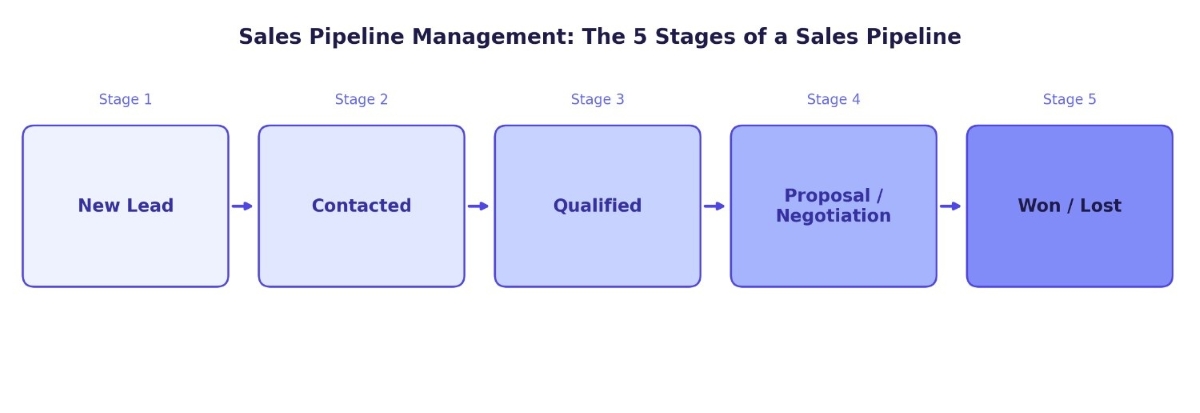
A common question people ask before adopting any system is simply: what does a pipeline actually look like, stage by stage? Most Indian sales teams find a 5-stage structure easiest to follow, though some businesses prefer a simpler 4-stage version by merging two steps.
| Stage | What Happens Here |
| 1. New Lead | A prospect enters the system from an ad, form, referral, or walk-in |
| 2. Contacted | First call or WhatsApp message is made to understand their need |
| 3. Qualified | The prospect shows genuine interest and budget fit |
| 4. Proposal / Negotiation | Pricing is shared, and objections are discussed |
| 5. Won / Lost | The deal closes successfully or is marked lost for future reference |
Some frameworks combine “Contacted” and “Qualified” into a single stage, giving a leaner 4-stage pipeline. Either version works fine — what matters more is that your team consistently updates each stage as a deal moves forward, rather than which exact number of stages you use.
The Real Productivity Problems Indian Sales Teams Face
Before jumping into solutions, it helps to understand what’s actually slowing teams down. Based on patterns we see across industries — from real estate to interior design to healthcare services — a few issues show up again and again:
Scattered information
Leads come in from Facebook, Google Ads, referrals, and walk-ins, but they all live in different places. According to HubSpot’s State of Marketing Report, nearly 40% of salespeople still rely on informal methods like spreadsheets and email to track customer data — a habit that becomes unmanageable once lead volume crosses even fifty a month.
Manual follow-ups
Salespeople rely on memory or handwritten notes to remember who to call back, which naturally leads to missed opportunities. This isn’t just an Indian SMB problem either — Salesforce’s State of Sales report (based on a survey of over 4,000 sales professionals globally) found that reps spend only about 40% of their workweek actually selling, with the rest eaten up by manual data entry, planning, and admin work.
No visibility for managers
Without a centralized view, sales managers can’t tell whether a slow month is due to fewer leads or poor follow-up discipline.
Duplicate work. Two team members sometimes contact the same lead, which looks unprofessional and wastes effort.
Delayed reporting. Since everything is tracked manually, monthly reports take days to prepare — and are often outdated the moment they’re shared.
These aren’t small inconveniences
Together, they quietly eat into revenue every single month. This is precisely why a structured sales process, backed by the right technology, has become less of a luxury and more of a necessity for growing businesses.
A Quick, Real-World Example
Consider a small interior design firm in Kolkata that runs Meta Ads for lead generation. Every day, ten to fifteen leads come in through Facebook forms. Without a system, these leads land in an inbox, get copied into an Excel sheet by hand, and are then split between two salespeople over WhatsApp.
By the time a salesperson actually calls back, a full day may have passed. Meanwhile, the prospect has likely already spoken to two competitors. This single delay — caused entirely by a lack of structure — can quietly cost thousands of rupees in lost business every month.
Now picture the same firm using a proper CRM built for growing sales teams. The moment a lead comes in, it’s automatically logged, assigned, and flagged for follow-up within minutes. Nothing sits unattended. This is the practical, everyday difference that pipeline management makes — not a theoretical benefit, but rupees saved and deals won.
How Sales Pipeline Software Changes the Game
Once a business adopts proper sales pipeline software, the entire sales process becomes visual and trackable. Instead of scrolling through spreadsheets, your team sees every deal organized into clear stages — New Lead, Contacted, Proposal Sent, Negotiation, Won, or Lost.
This shift might sound simple, but the impact is significant. When deals are organized by stage, salespeople instantly know what action to take next. There’s no confusion about whether a follow-up call is pending or already done. Consequently, teams spend less time figuring out “what’s next” and more time actually selling. Industry data backs this up: 42% of sales teams using CRM software rely on it specifically to automate meeting scheduling, and another 34% use it to automate follow-up reminders — the exact two problems most manual sales processes struggle with.
Additionally, a good pipeline tracking system automatically logs every interaction — calls, emails, WhatsApp messages, and notes — in one place. So even if a salesperson goes on leave or leaves the company, the next person can pick up the deal without starting from scratch. That continuity alone often saves businesses from losing deals during team transitions.
CRM for Sales Team: Turning Chaos into a Repeatable Process
A good CRM for sales team management does more than store contact details. In turn, it builds a repeatable process that your entire team can follow, regardless of individual experience level. This is especially useful for growing businesses that are onboarding new salespeople frequently, since new hires can simply follow the system instead of learning the ropes through trial and error.
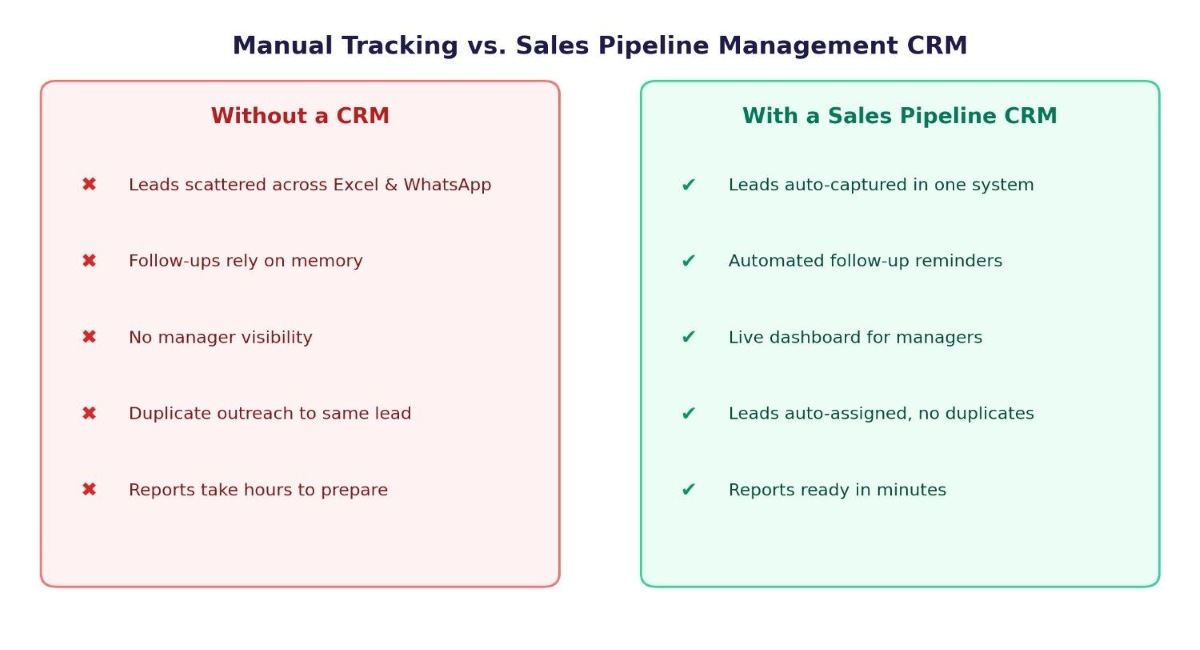
Here’s a quick comparison of how things typically look before and after adopting a proper sales tracking system:
| Sales Activity | Manual Process (Excel/WhatsApp) | With a CRM for Sales Team |
| Lead capture | Copied manually from ads, forms, calls | Automatically captured and assigned |
| Follow-up reminders | Relies on memory or personal notes | Automated reminders and alerts |
| Deal stage tracking | Updated inconsistently, if at all | Visual pipeline updated in real time |
| Manager visibility | Monthly or weekly manual reports | Live dashboard, anytime access |
| Team handovers | Information often lost | Full history retained automatically |
| Reporting time | Several hours to days | A few minutes |
As the table shows, the difference isn’t just about convenience — it directly affects how much revenue a sales team can realistically close in a month. Furthermore, when the process is standardized, training new salespeople becomes far quicker since everyone follows the same repeatable workflow.
Lead Tracking Software: Never Losing Another Prospect
One of the most common complaints we hear from business owners is, “We’re getting leads, but half of them are never followed up properly.” This is almost always a symptom of poor lead tracking software — or no system at all.
With a reliable lead capture system in place, every lead is automatically logged the moment it comes in, whether from a Facebook ad, a Google form, or a referral call. Nothing sits unnoticed in someone’s personal notebook. Moreover, leads can be automatically assigned to the right salesperson based on location, product interest, or workload, which removes the guesswork entirely.
This matters even more for businesses running paid campaigns. If your Meta Ads or Google Ads are generating leads but your team can’t act on them quickly, you’re essentially paying for traffic that goes nowhere. In contrast, a system built around solid lead management ensures every rupee spent on advertising has a fair chance of converting into a paying customer.
Deal Tracking Software: Closing More, Faster
Once a lead becomes a genuine prospect, the real challenge begins — moving them through negotiation without losing momentum. This is where deal tracking software proves its worth.
Instead of relying on memory to recall where a deal stands, your team can instantly check the last conversation, pending objections, quoted price, and expected closing date. As a result, follow-ups become sharper and more relevant, rather than generic check-ins that prospects tend to ignore.
Additionally, this kind of deal flow visibility often highlights conversations that have gone quiet for too long — say, no activity in seven or ten days. This gentle nudge alone helps sales teams revive stalled conversations before the prospect moves on to a competitor. Over time, this consistent follow-up discipline is often what separates high-performing sales teams from average ones, and it’s a core reason structured pipeline tracking works so well when applied consistently.
Sales Management Software: Giving Managers Real Visibility
For sales managers and business owners, the biggest frustration is often not knowing what’s really happening on the ground until it’s too late. This is where sales management software becomes essential rather than optional.
With a proper system, managers get a live view of:
- How many leads came in this week versus last week
- Which salesperson is converting well, and who’s struggling
- Where deals are getting stuck in the pipeline
- Expected revenue based on deals in the “Negotiation” or “Proposal Sent” stage
Consequently, decisions become data-driven rather than based on gut feeling. If a particular salesperson has plenty of leads but poor conversion, that’s a coaching issue. If someone has excellent conversion but very few leads, that’s a lead-distribution issue. Good reporting tools make these patterns obvious almost instantly, instead of requiring weeks of manual digging through spreadsheets.
What Is the Best CRM for Sales Pipeline Management in 2026?
The best CRM for pipeline management in 2026 is one that fits how your team actually sells, not the one with the longest feature list. For most Indian SMBs, that means a platform combining WhatsApp and call tracking, an easy visual pipeline, and India-friendly pricing — rather than a heavyweight global system built for enterprise sales floors abroad.
To put this in perspective: Zoho CRM’s paid plans typically run from roughly ₹800 to ₹2,600 per user per month depending on the tier, and while it offers real depth, new admins often spend two to three weeks figuring out which modules they actually need. Freshsales, built by Indian unicorn Freshworks, is lighter and cleaner but averages around 18 days to implement. Salesforce sits at the enterprise end, with Professional and Enterprise tiers running into thousands of rupees per user per month — powerful, but built for sales floors far larger than a typical Indian SMB team. For a 5-15 person sales team that wants to be live within a week rather than a month, these platforms are frequently overbuilt for the job.
According to a detailed 2026 pipeline management guide by Forecastio, clear stage definitions and regular pipeline reviews are two of the biggest factors behind healthy, predictable sales results. That principle holds true whether you’re a large global team or a five-person business in Kolkata.
Not every CRM is built the same way, and for Indian small and mid-sized businesses, a few things matter more than flashy features:
Simplicity
If your team needs a week of training just to log a lead, adoption will fail. Look for a clean, intuitive interface.
WhatsApp and call integration
Since most Indian sales conversations happen over calls and WhatsApp, your CRM should track these natively, not as a bolted-on afterthought — including the payment-in-chat flows (UPI-linked checkout inside WhatsApp) that have become standard for Indian buyers in 2026.
Data compliance
With the DPDP Act 2023 now actively shaping how Indian businesses must handle customer data — consent, storage, and deletion requests — a CRM that isn’t built with Indian data-privacy norms in mind can quietly become a compliance liability, not just a sales tool.
Affordability
Enterprise-grade pricing rarely makes sense for a growing SMB. Look for transparent, India-friendly pricing rather than per-user costs that scale unpredictably.
Local support
Getting help in your time zone, in a language your team understands, makes a real difference during setup.
Room to grow
As your team expands from five salespeople to fifty, your CRM should scale without forcing you to switch platforms.
This is exactly the gap 99Sales CRM was built to fill. Designed specifically for Indian SMBs, 99Sales CRM brings together sales pipeline management, lead capture, and deal management into one simple, affordable, DPDP-conscious platform — without the multi-week onboarding or per-module pricing complexity that larger global CRMs often carry. Instead of forcing your team to adapt to rigid enterprise workflows, it’s built around how Indian sales teams actually work day to day, including WhatsApp-first communication and India-specific pricing. You can also read our detailed breakdown of the best CRM software for small businesses in India for a wider comparison of options.
What Happens When Teams Delay Adopting a Proper System?
It’s worth pausing here. Many businesses put off fixing their sales process until it becomes a real crisis. In practice, waiting rarely means things stay the same. It usually means the problems pile up.
As lead volume grows, manual tracking gets much harder, not just a little harder. A team that manages forty leads a month on spreadsheets often struggles badly at two hundred leads a month. This mirrors a pattern SuperOffice has documented among growing sales teams: pipelines that aren’t actively managed tend to leak revenue quietly, long before anyone notices. By the time the business notices, months of revenue may have already slipped away quietly inside a messy spreadsheet.
So the earlier a growing business adopts structured pipeline management, the smaller the disruption, and the faster the returns.
Better sales pipeline management isn’t about adding more software for its own sake. It’s about removing the friction that quietly slows your team down every day — the missed follow-up, the lost lead, the manager who learns about a problem three weeks too late. If you’re still deciding whether to make the switch, our guide on CRM vs Excel for lead management breaks down the trade-offs in more detail.
Conclusion
Ultimately, better pipeline management isn’t about adding more software for its own sake. It’s about removing the friction that quietly slows your team down every single day — the missed follow-up, the lost lead, the manager who finds out about a problem three weeks too late. The numbers make the case on their own: CRM adoption is widely cited as delivering an average return of $8.71 for every $1 invested (Nucleus Research), and that return compounds the moment your team stops losing leads to disorganization. Once that friction is gone, sales teams naturally sell more, simply because they’re spending their energy on selling rather than searching for information.
If you’re still relying on spreadsheets and memory to run your sales process, it might be worth exploring what a purpose-built platform like 99Sales CRM can do for your team’s day-to-day productivity.
Frequently Asked Questions
1. What is sales pipeline management in simple terms?
It’s the process of tracking every deal from the first contact to the final sale, organized into clear stages so your team always knows what needs to happen next.
2. How does a CRM improve sales team productivity?
A CRM removes manual, repetitive work like tracking leads on spreadsheets or remembering follow-ups. In turn, it automates reminders, organizes deals visually, and gives both salespeople and managers real-time visibility, which directly saves hours every week.
3. Is sales pipeline software only useful for large companies?
Not at all. In fact, small and mid-sized businesses often benefit more, since they typically don’t have dedicated operations teams to manage things manually. An affordable, well-built system levels the playing field for growing businesses.
4. What’s the difference between lead tracking software and a full CRM?
It usually focuses on capturing and organizing new leads. A full CRM goes further, covering the entire journey — from lead to deal to closed sale — along with reporting and follow-up automation.
5. Can deal tracking software work with WhatsApp, since most Indian sales happen there?
Yes, modern tools like 99Sales CRM are built to log calls and WhatsApp conversations alongside deal stages, so nothing gets missed just because it happened outside email.
6. How long does it take for a sales team to adopt new sales management software?
With a simple, intuitive platform, most teams start seeing value within the first week. In contrast, complex enterprise systems can take two to three weeks just for admin setup, and sometimes months for full rollout — which is why simplicity should be a priority for smaller teams.
7. Will a CRM replace the need for a skilled sales team?
No. Instead, a CRM supports and organizes your sales team’s efforts; it doesn’t replace the human relationship-building that closes deals. Simply put, it removes the administrative burden so your team can focus purely on selling.
8. What are the stages of a sales pipeline?
Most teams use five stages: New Lead, Contacted, Qualified, Proposal/Negotiation, and Won/Lost. Some businesses simplify this into four stages by merging Contacted and Qualified, though the core idea stays the same either way.
9. What is the best CRM for sales pipeline management in 2026?
There’s no single universal answer, since the best choice depends on team size, budget, and how sales conversations actually happen. Larger platforms like Zoho, Freshsales, and Salesforce offer real depth but come with longer onboarding and higher per-user costs — often more than an Indian SMB with a 5-15 person sales team needs. For businesses that want to be live within a week, with WhatsApp-native tracking, India-specific pricing, and DPDP-conscious data handling, a focused platform like 99Sales CRM generally outperforms larger global systems that weren’t built with local sales habits in mind.
10. How do I know if my business actually needs pipeline management software?
If you’ve ever lost track of a lead, missed a follow-up, or struggled to explain why sales dipped in a given month, that’s usually a clear sign your current process needs more structure — and that’s exactly what a proper pipeline system provides.
Your Sales Pipeline Deserves Better Than a Spreadsheet
Every stage you just read about — New Lead, Contacted, Qualified, Proposal, Won or Lost — should update itself as your team works, not sit frozen in an Excel column nobody remembers to touch. 99Sales CRM turns this exact pipeline into a live, visual system built for how Indian sales teams actually sell: WhatsApp-first, India-priced, and ready in days, not weeks.
No per-user fees. No features you’ll never use. Just a pipeline that finally tracks itself.
Start Your Free Trial at 99Sales CRM
About This Article
Written by the 99Sales CRM Team — sales and CRM specialists focused on helping Indian SMBs build faster, more consistent sales processes. 99Sales CRM is built for the Indian market, with native WhatsApp integration, INR pricing, and features designed around how Indian sales teams actually operate.
Last updated: July 2026